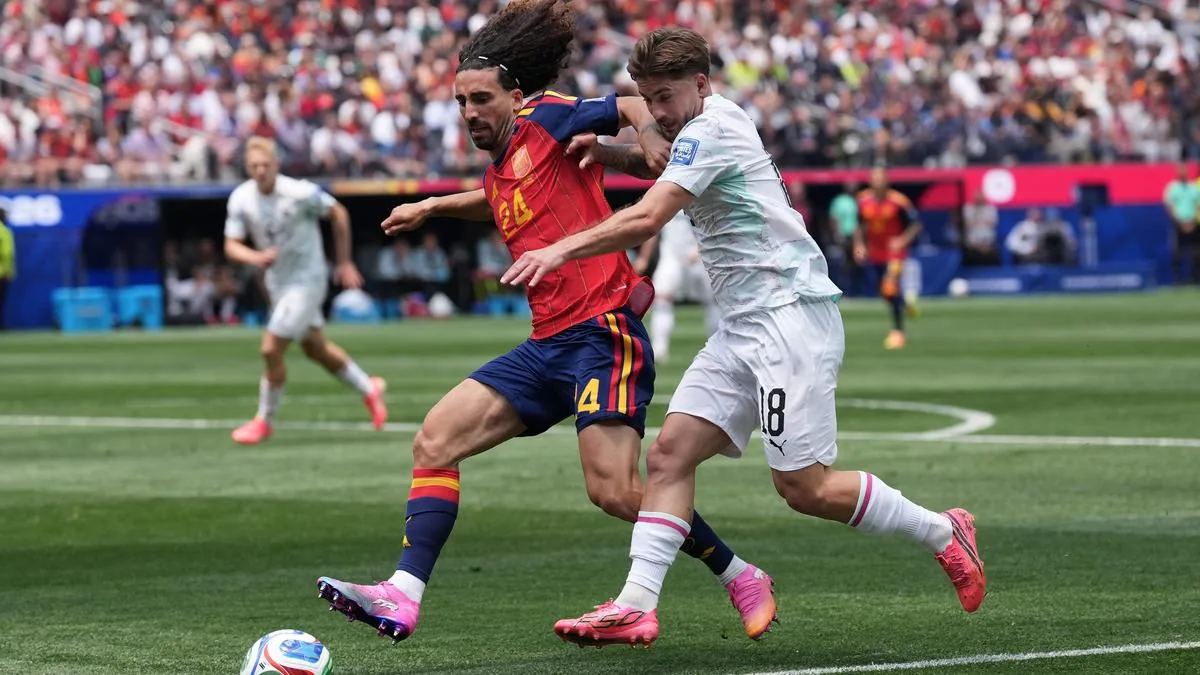
During the FIFA World Cup 2026 round of 32 match between Spain and Austria in Los Angeles, a goal scored by Marc Cucurella was disallowed, leading to confusion among fans. The incident occurred just before the half-hour mark when Cucurella found the net from a corner kick. However, the referee, Glenn Nyberg, ultimately ruled out the goal.
The decision to disallow the goal stemmed from a foul committed by Pau Cubarsi on Austrian goalkeeper Alexander Schlager during the build-up. According to Rule 10.1 of the laws of football, established by the International Football Association Board, a goal is valid only if no offence has been committed by the scoring team. Cubarsi’s foul was deemed to violate this rule, providing sufficient grounds for the referee and the Video Assistant Referee (VAR) team to disallow the goal.
VAR and Offside Interference
Reports indicate that the VAR review panel and the on-field referee made the final call, with the decision sparking debate regarding consistency in officiating. The disallowed goal was attributed to FIFA Law 11, specifically the ‘interference with an opponent’ clause. This clause states that a player in an offside position can be penalised if they interfere with an opponent, even without touching the ball.
In this instance, a Spanish player in an offside position was judged to have impacted the Austrian goalkeeper’s ability to make a save. Semi-automated offside technology (SAOT) was used to flag the offside position, after which the VAR team assessed whether the offside player’s proximity constituted ‘interference with an opponent’ under Law 11, Section 2. This assessment led to the recommendation to disallow the goal.
The ‘interference with an opponent’ clause in Law 11, Section 2, specifies that a player in an offside position is penalised if they ‘clearly attempt to play a ball which is close when this action impacts on an opponent’ or if they make ‘an obvious action which clearly impacts on the ability of an opponent to play the ball.’ The 2024–25 guidance notes from the International Football Association Board (IFAB) expanded this interpretation to include scenarios where an offside player’s proximity ‘prevents an opponent from playing or being able to play the ball by clearly obstructing the opponent’s line of vision or movement.’
Spain’s Reaction and Broader Controversy
The decision reportedly caused significant frustration within the Spanish camp. Multiple Spanish players reportedly surrounded the referee following the call, with Cucurella expressing visible disbelief. The arguments from the Spanish side, as conveyed through post-match press conferences, focused on two main points: the degree of interference and consistency in rule application.
Spanish coaching staff reportedly questioned whether the offside player genuinely obstructed the goalkeeper’s line of sight, noting that the goalkeeper appeared to dive in the correct direction. This suggested that the goalkeeper might not have been impeded, raising questions about whether the player’s presence ‘clearly impacted’ his ability to make the save.
Furthermore, the Spanish camp reportedly highlighted at least one other goal earlier in the tournament, in a different group-stage fixture, where a similarly positioned offside player was not deemed to have interfered, and the goal was allowed to stand. This perceived inconsistency in applying the same technology and rulebook to comparable situations has led to questions about the system’s ability to eliminate subjectivity.
The incident involving Cucurella’s disallowed goal is not isolated, as officiating controversies have reportedly been a feature of the 2026 World Cup. Another notable incident mentioned was the Folarin Balogun red card during the USA vs Bosnia-Herzegovina match, which also drew criticism regarding VAR intervention consistency. These events contribute to a broader sentiment among various teams that while technology has advanced, the human judgment aspect of VAR remains contentious.
Coaching circles are reportedly discussing that the IFAB’s 2024–25 guidance notes broadened the definition of interference, lowering the threshold for disallowing goals from offside positions. This means that every remaining team in the knockout rounds must now consider the risk that any set-piece goal could be retroactively disallowed due to the position of a teammate who did not even touch the ball.

The incident has become a significant talking point of the tournament, not just for the immediate impact on the match, but for the ongoing debate it fuels about the application of rules and technology in modern football. The decision to disallow Cucurella’s goal against Austria was made on July 2, 2026.
Read Also
Source: sportstar.thehindu.com