
The 23rd Commonwealth Games in Glasgow commenced with an indoor spectacle at the OVO Hydro, celebrating the city’s heritage and emphasizing sustainability. King Charles III officially declared the Games open, having previously placed his message in the King’s Baton at Buckingham Palace last year. This baton completed a 500-day global relay through 74 Commonwealth member nations.
During the opening ceremony, King Charles III highlighted the baton’s additional message, which advocated for efforts to eliminate plastic pollution from oceans and waterways. He stressed the importance of protecting 30% of the world’s oceans by 2030 to ensure thriving communities, businesses, and enhanced global food resources through marine reserves and no-take zones.
The ceremony blended traditional Gaelic heritage with contemporary music, including pop, rap, and electronic performances, reflecting Glasgow’s identity as a UNESCO City of Music. Notably, the opening ceremony was staged entirely within the 14,300-capacity indoor bowl, a first for the Commonwealth Games. Athletes from the 74 nations paraded into the arena at the beginning of the show, another departure from previous traditions.
Sporting Highlights and Community Engagement
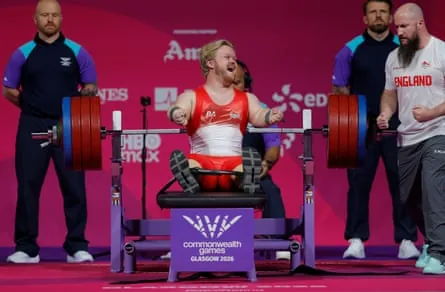
Despite some initial challenges, such as a broken rope at the Tollcross International Swimming Centre that a volunteer fixed, the Games have showcased moments of spirit and determination. In para powerlifting, England’s Mark Swan secured the first gold medal, bench-pressing 222kg, a weight more than three times his bodyweight. His victory was initially confusing as he had the same score as Nigeria’s Roland Ezuruike, with officials later explaining a second decimal point separated them.
The Games also featured Botswanan lawn bowler Diza Mphotho, who captivated the crowd at the indoor SEC arena with his bucket hat and distinctive style. Mphotho, an IT worker, took up the sport a decade ago, viewing it as an opportunity to travel. He uses nearly all of his annual leave to participate in the Games, finding the experience worthwhile.
The Glasgow 2026 Games represent a scaled-down model compared to previous editions, following Victoria’s withdrawal in 2023 due to rising costs. Glasgow stepped in as host, adopting a compact, lower-cost structure with 10 sports and six integrated Para sports, making it the largest integrated Para sport program in Commonwealth Games history. These events are held across four existing venues: Scotstoun Stadium, the Scottish Event Campus, Glasgow International Arena, and Tollcross International Swimming Centre.
Challenges and Adaptations
While the Games have seen enthusiastic commentators and involved crowds, there have been fewer international fans than usual. This is largely attributed to economic factors, as the lack of an athletes’ village meant athletes and officials are staying in hotels, leading to high accommodation prices for others. Despite this, Phil Batty, the chief executive of Glasgow 2026, stated that many people are still traveling to Scotland to watch the events, often staying outside the city.
The OVO Hydro, a 10,000-seater venue, is hosting netball for nine days with 21 sessions, a significant increase from past Games that typically only held the final and bronze medal match there. Despite some concerns about empty seats for certain netball matches, more tickets have been sold for netball than ever before in Scotland’s history.
The opening ceremony included performances by electro-folk duo Valtos, pipe bands, and Scottish artists like Nathan Evans, Tom Walker, and KT Tunstall. Actor Sam Heughan also participated in a segment featuring a representation of the Loch Ness Monster. The event also drew on Gaelic working traditions, with choreography inspired by historical textile production and rhythmic Gaelic songs.
The Indian contingent, led by Olympic medallists Mirabai Chanu and Lovlina Borgohain, received a warm reception. The male athletes wore navy blue suits, while the female participants were dressed in sarees and blazers. The Commonwealth flag was raised at the center of the stage, with Scotland’s lawn ball player Paul Foster, 3×3 basketball player Robyn Love, and Leslie Roy reading the oath.
Commonwealth Sport President Donald Rukare noted that these reimagined Games mark the beginning of a new chapter for the Commonwealth Sport Movement, celebrating world-class sport, friendship, and the unique ability of the Games to bring people together. The opening ceremony set the tone for the Games, which officially began on July 24, 2026.
Source: theguardian.com