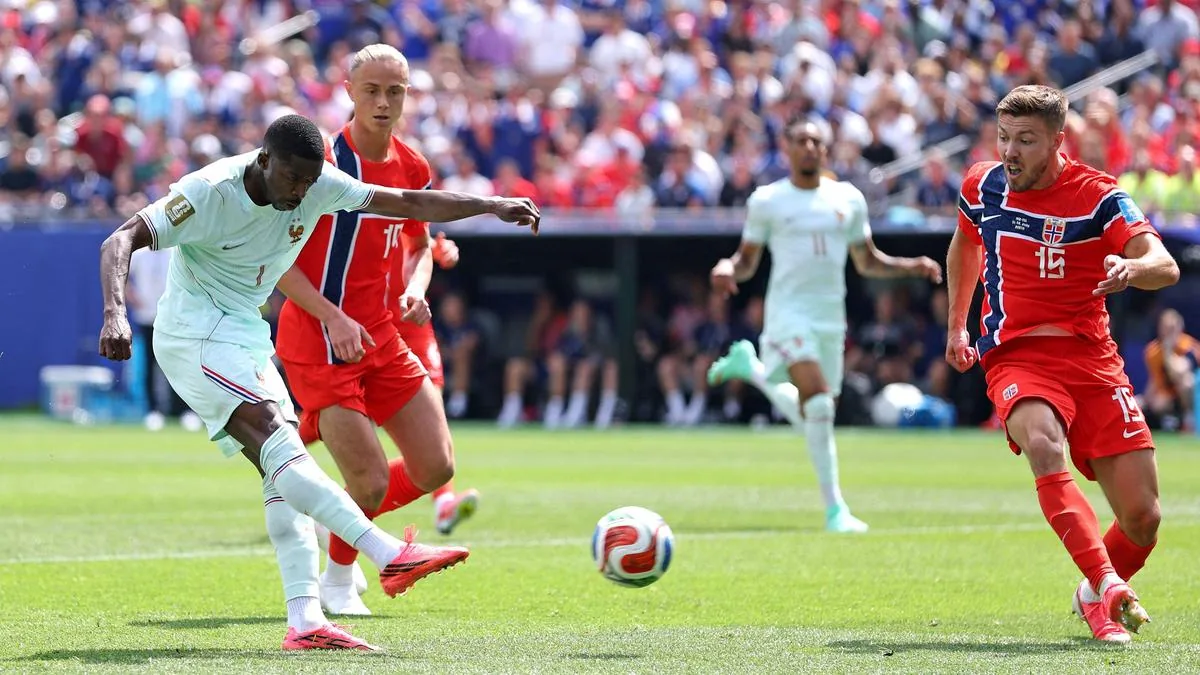
Norway coach Stale Solbakken described the decision to rest key players, including striker Erling Haaland, in their recent World Cup group stage match against France as a “no-brainer.” The match, which saw France secure a 4-1 victory at Boston Stadium, featured a significantly altered Norway lineup, with 10 changes made to the starting XI.
Ousmane Dembele was a standout performer for France, scoring a first-half hat-trick within 25 minutes. France’s captain, Kylian Mbappe, hit the crossbar early in the game before setting up Dembele for the opening goal in the seventh minute. Dembele added a second with an angled shot. Norway, who had already qualified for the knockout stages, managed to pull one goal back through Thelo Aasgaard.
The decision to rest Haaland, who had scored four goals in Norway’s previous two group games, marked the first time he had not started for the national team since 2024. Solbakken explained that the changes were a collective decision involving himself, the medical staff, and some of the players. He noted that five or six players, including the entire defensive line and some midfielders, were significantly affected after 80 minutes in their game against Senegal.
The only consideration for Solbakken was the disappointment for Norway fans who would have wanted to see Haaland and Martin Odegaard play. Former England striker Ian Wright commented before the game that if Haaland needed rest for the later stages of the tournament, he would take it. While Haaland was on the bench, his deputy, Jorgen Strand Larsen, missed a penalty that could have narrowed the score to 3-2 after half-time.
Strategic Rationale and Player Welfare
Solbakken defended his strategy, citing the short turnaround between Norway’s last game on Tuesday and the match against France on Friday. He emphasized the importance of player fitness for the knockout stages, especially given Norway’s physical style of play. Former Republic of Ireland midfielder Roy Keane supported Solbakken’s reasoning, highlighting that Norway, participating in their first World Cup since 1998, is not yet accustomed to tournament football.
Keane suggested that Norway’s priority was to advance from the group, which they achieved, and that the manager likely believed it would be challenging to overcome France with a full-strength squad. He added that while a winning mentality is important, there is also a bigger picture, acknowledging the differing expectations between Norway and France, with the latter expected to contend for the World Cup title.
France assistant coach Guy Stephan, who was deputizing for Didier Deschamps, stated he was not surprised by Norway’s numerous changes. Stephan noted that since Norway had already qualified, Solbakken would naturally want to prepare for the Round of 32. He mentioned that the effectiveness of Norway’s decision would become clear in four days.

The changes meant that Norway faced a longer journey for their next fixture. France topped Group I with three wins, earning them a last-32 match at New York New Jersey Stadium on June 30 against the runners-up of Group F or G. Norway, however, will travel approximately 1,100 miles from their base in Greensboro, North Carolina, to Arlington, Texas, to play Ivory Coast on the same day. Had they topped the group, their travel distance would have been significantly shorter.
Historical Precedent and Fan Reaction
The decision to make extensive changes in a World Cup match is not unprecedented. Norway is only the fourth team to make 10 or more changes to their starting XI in a single edition of the tournament. Spain made 11 changes in 2006 against Saudi Arabia and won their final group-stage game, but subsequently lost 3-1 to France in the last 16. In contrast, Belgium made 10 changes in 2018, defeated Japan 3-2, and then went on to beat Brazil 2-1 in the quarter-finals before being eliminated by France.
Former Scotland winger Pat Nevin highlighted the complexities of such decisions, particularly regarding the travel distances involved in the tournament. He suggested that ensuring players are fit and ready for the knockout stages is paramount. Wright expressed surprise at Norway’s many changes, especially since they had used the same starting XI for their victories over Iraq and Senegal.
Despite some initial head-scratching among fans at Boston Stadium when the team news was announced, many Norwegian supporters, who had traveled extensively to the United States, continued their traditional Viking-style row celebration throughout the match. Haaland himself had previously expressed his thoughts on facing France, stating after Norway qualified that he didn’t care much about that game and predicted France would likely win against them and potentially the entire tournament.
Norway’s next challenge is against Ivory Coast on June 30.
Read Also
Source: bbc.com