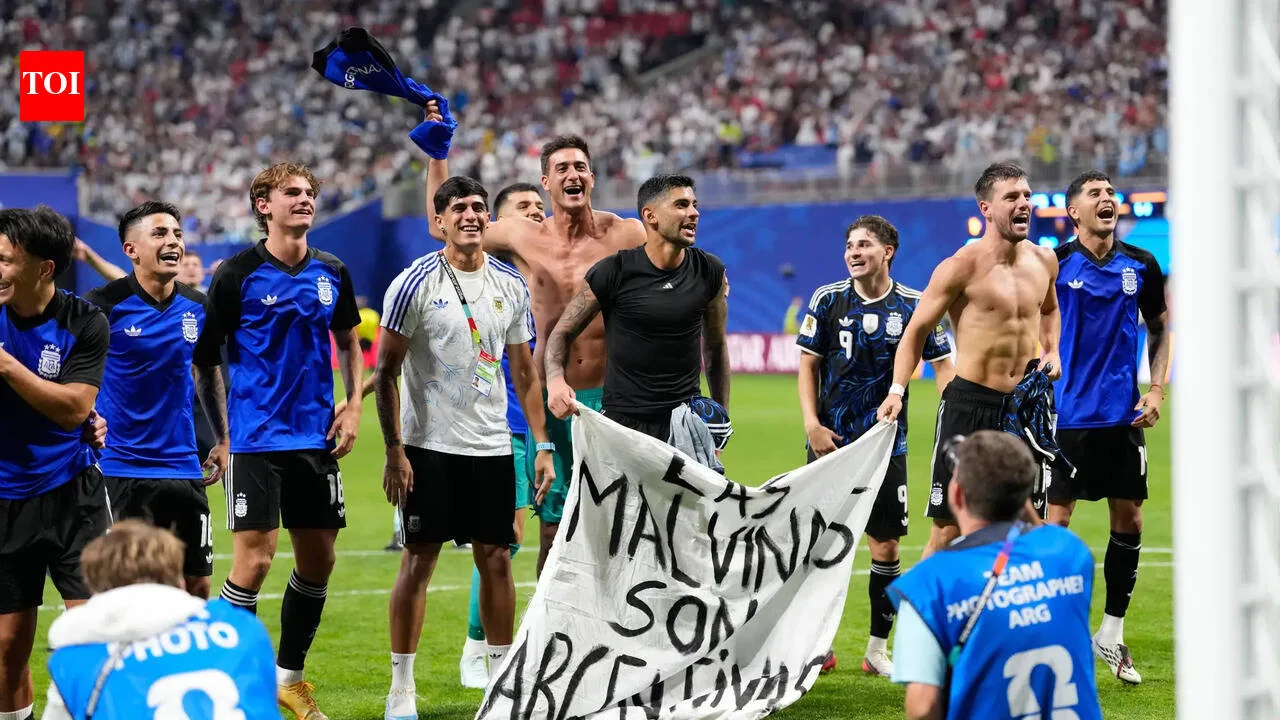
The White House has defended the Argentinian football team’s right to free speech after players displayed a banner supporting their country’s territorial claim to the Falkland Islands. This incident occurred during celebrations following their World Cup semi-final victory against England. The banner, which read “Las Malvinas son Argentinas” (The Falklands are Argentine), has led to calls for an investigation by FIFA.
Andrew Giuliani, head of the White House FIFA task force, stated on Friday that the team had the opportunity to “make those statements” in the US. He referenced free speech protections in the US Constitution, saying, “We believe in our First Amendment rights here in the United States of America.”
FIFA investigation and UK response
The display of the banner has prompted a significant reaction, particularly from the United Kingdom. Downing Street has supported calls for FIFA to investigate the incident. The prime minister’s official spokesperson affirmed the UK’s commitment to the Falkland Islands, stating that while the World Cup might not belong to the UK, the Falkland Islands “definitely are.”
The UK government has indicated that any potential action against the Argentina players is a matter for FIFA, echoing the view that the governing body should investigate. The government of the Falkland Islands expressed disappointment but not surprise, hoping that FIFA would “sanction all behaviour of this nature in line with its own rules.” They also stated a desire for politics not to be brought into sport and for the Islands and their people not to be used as a “political football.”
FIFA has confirmed that its independent disciplinary committee is reviewing the incident as part of its standard procedures. This assessment involves considering match reports and relevant circumstances before deciding on potential steps based on the FIFA Disciplinary Code. The review focuses on Article 34.3 of the 2026 FIFA World Cup Match Protocol, which prohibits political, religious, or personal messages before, during, or after matches.
The FIFA Disciplinary Code categorizes the use of a sporting event for political or non-sporting demonstrations as a potential offense. Sanctions for such offenses can range from warnings and fines to sporting penalties, depending on the severity and context of the incident.
Political figures in the UK have called for strong action. Liberal Democrat leader Ed Davey urged FIFA to suspend all players involved in displaying or surrounding the banner. British minister Peter Kyle described the gesture as “totally inappropriate,” emphasizing that politics should be kept out of football and that he expected a thorough investigation from FIFA.
Potential sanctions and precedents
The central question revolves around whether the players involved could face suspension for the upcoming World Cup final. While calls for suspensions have intensified, FIFA’s disciplinary position remains unclear, as no formal decision has been announced.
Reports from some Spanish and Argentine outlets suggest that while disciplinary action is anticipated, sporting suspensions that would affect the World Cup final are considered less likely. Instead, sanctions could potentially include warnings or financial penalties directed at the players or the Argentine Football Association (AFA).
Multiple reports indicate that any formal decision by FIFA’s disciplinary committee is unlikely to be issued until after the conclusion of the tournament. If this timeline is followed, any imposed sanctions would not impact player availability for the final against Spain. FIFA has not publicly confirmed the timing of its decision, maintaining uncertainty until the disciplinary process is complete.
Previous cases offer some context for how FIFA and other governing bodies have handled similar incidents. For example, UEFA imposed a one-match ban on Spain internationals Álvaro Morata and Rodri after they chanted “Gibraltar is Spanish” during Euro 2024 victory celebrations. At the 2018 World Cup, Switzerland’s Granit Xhaka and Xherdan Shaqiri received fines for political gestures during a match. Additionally, South Korea’s Park Jong-woo was suspended for displaying a political banner at the London Olympics.
FIFA also sanctioned Argentina in 2014 after a Falklands-related banner was displayed following a friendly match, which resulted in a financial penalty rather than sporting sanctions. These precedents suggest that while disciplinary action for political messaging is not uncommon, suspensions for major fixtures are typically reserved for cases deemed especially serious or repeated.
The Falkland Islands remain a subject of a sovereignty dispute between the UK and Argentina. In 2013, the people of the Falkland Islands voted overwhelmingly to remain a UK overseas territory, with 1,513 votes in favour out of 1,517 cast in the referendum.
Argentina vice-president Victoria Villarruel posted on X after the victory, stating that it “wasn’t just another match” and that “The Falklands are Argentine.” She added that while bringing banners to the stadium was banned, the sentiment was carried “in our blood and our hearts.”
The Argentina players also sang chants referencing the Falklands and Argentina greats Maradona and Lionel Messi after their 3-2 win over Egypt in the last 16. A brief conflict between Britain and Argentina over the territory occurred in 1982, leading to the deaths of 255 British military personnel, three islanders, and 649 Argentine soldiers.
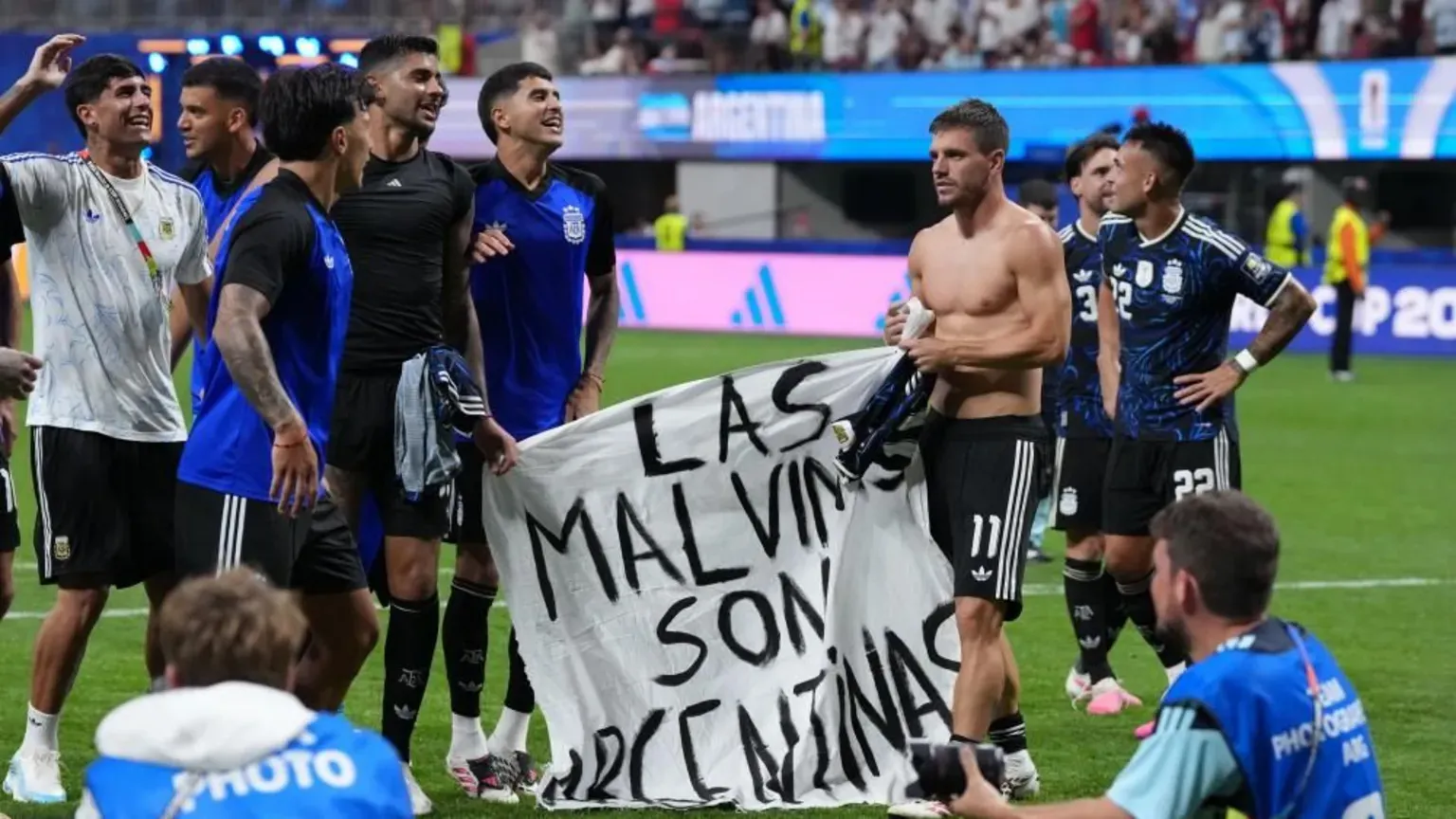
With Argentina preparing to face Spain in the World Cup final, the disciplinary process remains ongoing and unresolved, leaving FIFA’s eventual ruling as a key outstanding issue ahead of the tournament’s conclusion.
Read Also
- Enzo Fernández's social media post after Argentina's semi-final win sparks reaction
- Cardiff: Joe Root discusses young batters learning on the job in ODI cricket
- Rohit Sharma's international future uncertain as selectors eye younger talent
- Barcelona connection highlights World Cup final as Messi and Yamal prepare to face off
Source: bbc.com