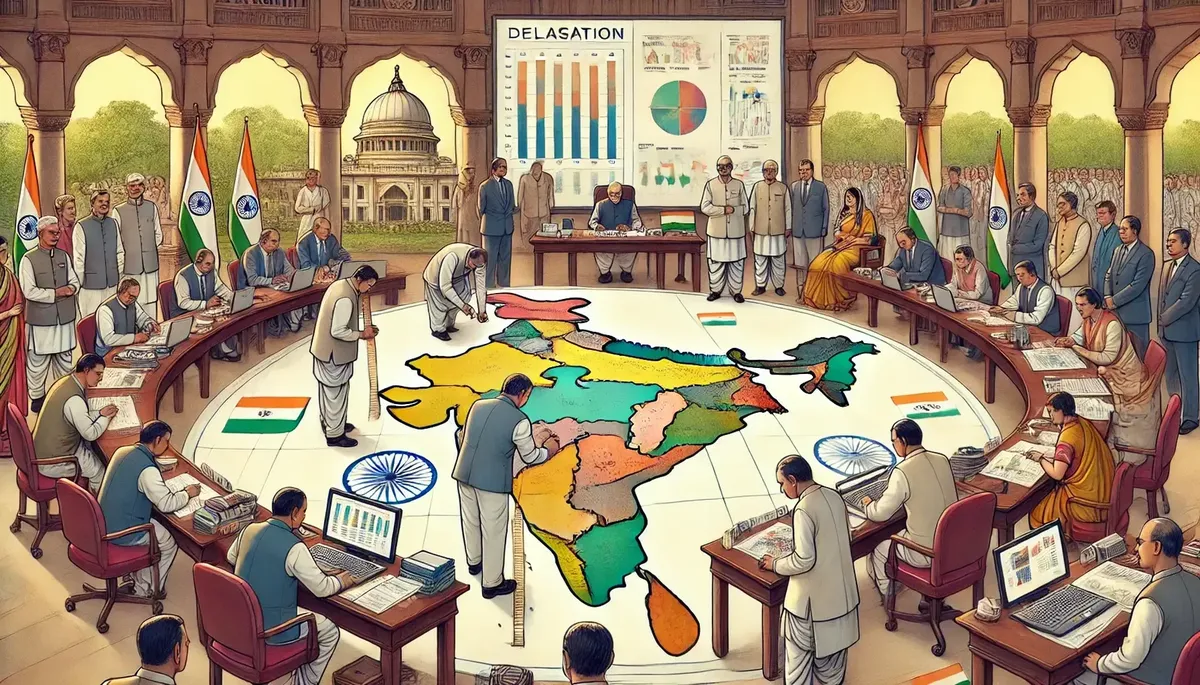
As India approaches a pivotal moment in its political landscape, the Union Government has proposed a significant increase in the strength of the Lok Sabha, aiming to expand its membership from the current 543 to a staggering 850 members. This ambitious plan is part of a broader initiative to amend the Constitution and redefine the electoral framework in the country.
On April 14, 2026, the government announced its intention to introduce a Bill that seeks to amend Article 82 of the Constitution, which governs the readjustment of parliamentary constituencies following each Census. This proposed amendment is particularly noteworthy as it aims to delete the stipulation that delimitation must occur only after the post-2026 Census, thereby allowing for a more immediate restructuring of parliamentary representation.
The current composition of the Lok Sabha has remained unchanged since it was last based on the 1971 Census, with the 84th Amendment Act of 2001 freezing constituency boundaries until the first census after 2026. With the latest published census being in 2011 and the next expected to conclude in 2027, this move could significantly alter the political dynamics in India.
As part of the proposed changes, the Bill will be discussed during a Special Session of Parliament scheduled for April 16 and 17, 2026. The legislation not only empowers the Central Government to constitute a Delimitation Commission but also stipulates that this Commission will be chaired by a person who is or has been a Judge of the Supreme Court. This provision aims to ensure that the delimitation process is conducted with the utmost integrity and judicial oversight.
Moreover, the Bill proposes a maximum of 815 members from the states and 35 from Union Territories, reflecting a more equitable distribution of representation across the nation. A particularly progressive aspect of this proposal is the inclusion of a provision for 33% reservation for women in the Lok Sabha and State Assemblies, marking a significant step towards gender parity in Indian politics.
In a statement regarding the Bill, officials noted, “The Bill provides that orders issued by the Delimitation Commission, once published in the Gazette of India, will have the force of law and cannot be called into question in any court.” This clause emphasizes the finality and authority of the Commission’s decisions, further underscoring the importance of this legislative change.
The implications of these developments are profound. By enabling a more responsive and representative Lok Sabha, the government aims to address the disparities that have arisen over decades due to population changes and demographic shifts. As the nation prepares for these changes, the political landscape is set for a transformation that could redefine electoral politics in India for years to come.
As the Special Session approaches, the anticipation surrounding the delimitation Bill continues to grow. With the potential for a historic reshaping of the Lok Sabha, all eyes will be on the Parliament as it deliberates on this landmark legislation.