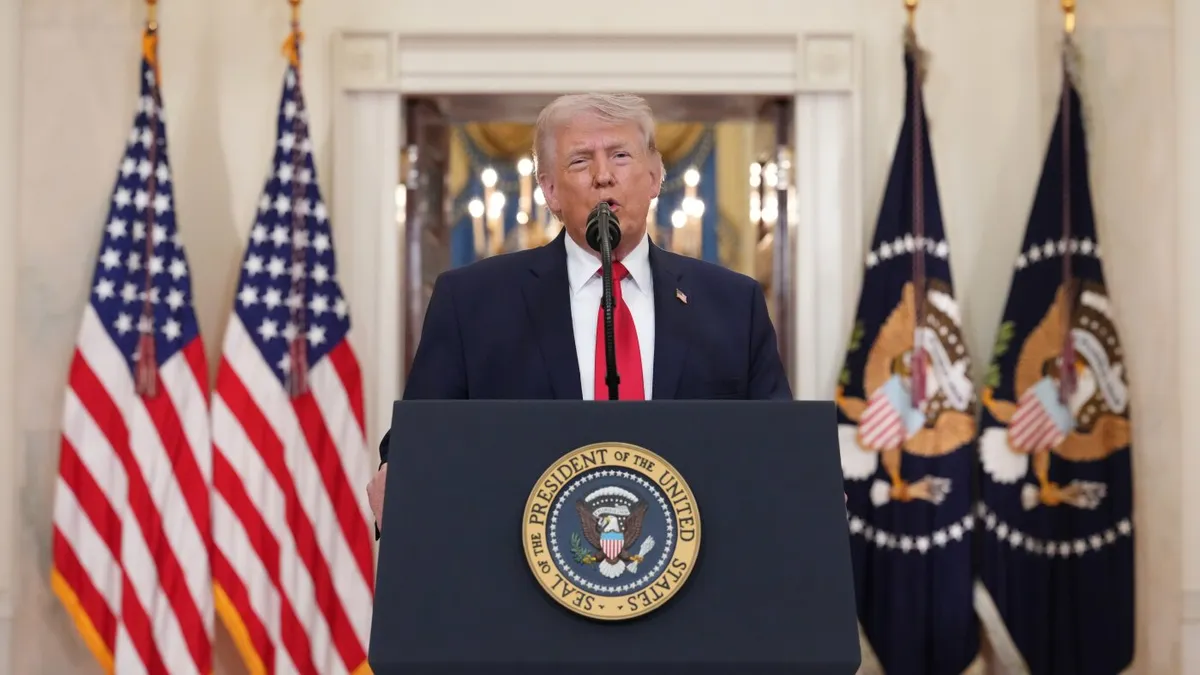
What does Donald Trump’s speech today reveal about the current state of U.S. military involvement in Iran? In his address, Trump asserted that the administration’s goals in the region are nearly achieved, suggesting a swift conclusion to the conflict.
Trump’s address, which was not officially announced by the White House but teased by Karoline Leavitt on social media, marked his first prime-time speech since the U.S.-Israeli strikes in Iran. The speech lasted approximately 20 minutes and was delivered at 9 PM ET.
During the address, Trump claimed, “In these past four weeks, our armed forces have delivered swift, decisive, overwhelming victories on the battlefield.” He indicated that the U.S. military would soon be “out of Iran pretty quickly,” with plans to engage only in targeted strikes.
He further stated, “I can say tonight that we are on track to complete all of America’s military objectives shortly, very shortly, we are going to hit them extremely hard over the next two to three weeks.” This timeline suggests a rapid escalation in military operations.
Supporting Trump’s claims, U.S. military officials have confirmed the elimination of around one-third of Iran’s missile capabilities, and according to U.S. CENTCOM commander, 92% of Iran’s large naval ships have been destroyed. These statistics highlight significant military progress.
However, the conflict has not been without consequences. The ongoing situation in Iran has led to rising gas prices, with the average price per gallon reaching $4, and a 27% increase in Brent crude prices since the war began. This has sparked public discontent reminiscent of past energy crises.
Despite the optimistic tone of Trump’s speech, uncertainties linger. The exact timeline for the end of the war remains unclear, and the effectiveness of the U.S. military objectives in Iran is still being evaluated. Details remain unconfirmed.
As the situation develops, the international community, including NATO allies, will be closely watching the U.S. approach to Iran and the implications for regional stability.