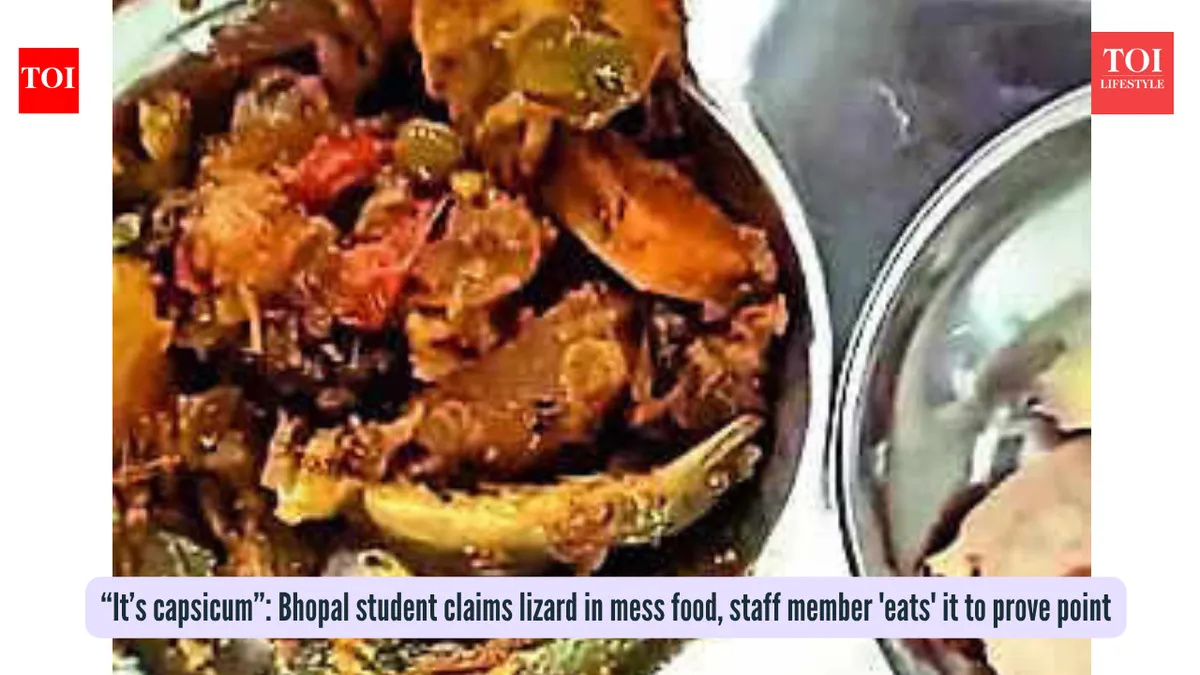
In Bhopal, India, a recent incident at the University Institute of Technology, RGPV, has raised serious concerns about food hygiene in hostel facilities. A student reported finding what he described as a lizard in his meal, igniting a debate over the quality and safety of food served in university hostels. Hostel food often becomes a topic of debate regarding hygiene, trust, and accountability.
The situation escalated when a staff member from the mess attempted to defend the food’s integrity by claiming the object was merely capsicum, or ‘Shimla mirch.’ To prove his point, he even consumed the item in question, a move that many found questionable. The incident was captured on video and quickly went viral on social media, drawing widespread attention.
The student, however, remained adamant, asserting that the object had a lizard’s eye, which he described in vivid detail: “Yeh pahu hai iske. Chipkali hai, uski aankh nikal rahi thi.” This stark contrast in perspectives has left many observers puzzled and concerned.
In response to the uproar, RGPV Director Sudhir Bhadoria assured the public that student health would not be compromised. He stated that the university has formed a committee to investigate the matter thoroughly. Bhadoria emphasized that strict action would follow if negligence was found during the inquiry.
As the investigation unfolds, it remains unclear whether the object was indeed a lizard or simply capsicum. Details remain unconfirmed, leaving students and parents anxious about food safety in the university’s mess.
This incident highlights the ongoing challenges faced by educational institutions in maintaining food quality and hygiene standards. The reactions from both the student and the staff member reflect a broader concern about accountability in food service operations.
With the university’s commitment to ensuring student safety, many are hopeful that the investigation will bring clarity to the situation. Observers are keenly watching to see what measures will be implemented to prevent such incidents in the future.
As the story continues to develop, it serves as a reminder of the critical importance of food safety in educational institutions, where students rely on these facilities for their daily sustenance.