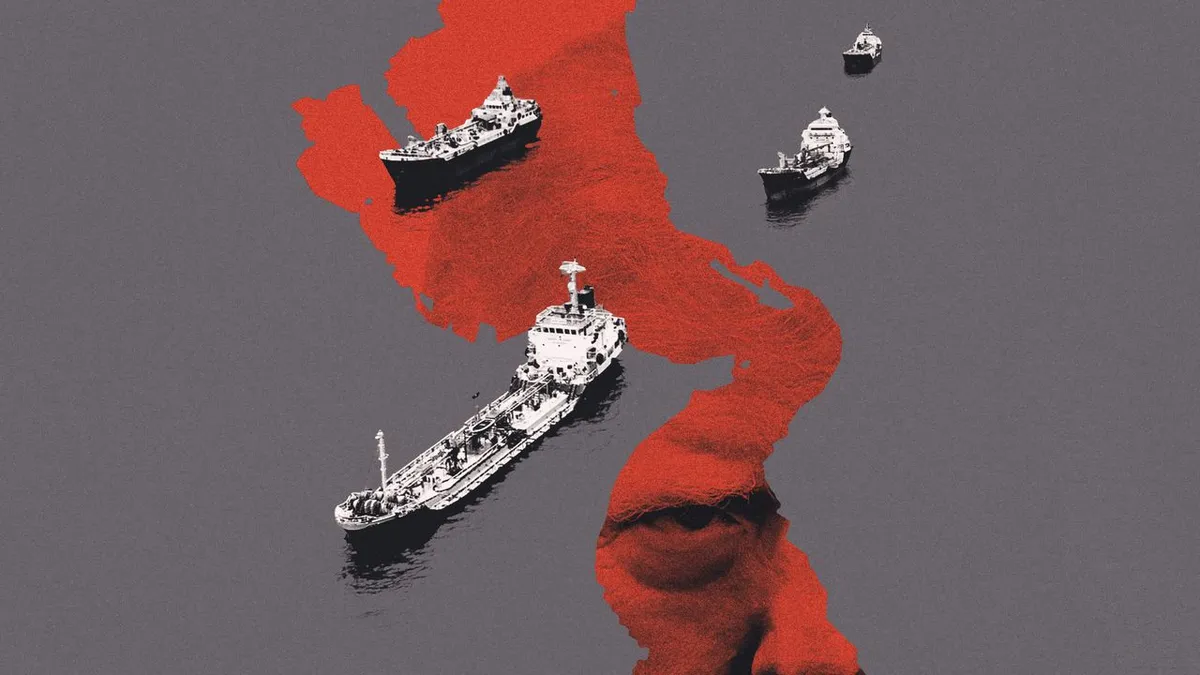
In a significant escalation of military tensions, Israeli fighter jets have targeted South Pars, the world’s largest natural-gas field, which is shared by Iran and Qatar. This operation is part of a broader strategy by the U.S. and Israel aimed at toppling the Iranian government and diminishing its regional influence. The strike comes amid heightened fears regarding the stability of the Strait of Hormuz, a crucial maritime corridor through which a fifth of the world’s oil and natural gas supply flows.
The immediate circumstances surrounding this military action are dire. Iran has issued threats to shut down the Strait of Hormuz as a deterrent against U.S. and Israeli strikes. In a bold move, President Trump demanded Iran’s unconditional surrender following the U.S.-Israeli strike that resulted in the death of Iran’s Supreme Leader. He warned that Iran must fully open the Strait of Hormuz within 48 hours or face the obliteration of its power plants, a statement that underscores the gravity of the situation.
Key moments
The operation, dubbed Operation Epic Fury, has reportedly eliminated Iran’s leadership and significantly degraded its capacity to terrorize the West. This swift and decisive military intervention aligns with Trump’s approach, which has been characterized as effective in dealing with threats to U.S. interests. The U.S. military has been collaborating closely with Israel in the region, reflecting a united front against perceived Iranian aggression.
Historically, the U.S. military has mapped out various scenarios involving war with Iran, anticipating potential strategies and outcomes. This long-standing focus on Iran has seen eight American presidents grapple with the complexities of the Iranian regime since the 1979 revolution. The current administration’s actions are viewed as a continuation of this fraught legacy, with Trump’s military interventions drawing parallels to the principle of ‘peace through strength’ championed by Ronald Reagan during the Cold War.
As the situation unfolds, reactions from various quarters have begun to emerge. Chris Hedges, a prominent critic of the new world order, articulated a stark view: “The new world order is one where the weak are obliterated by the strong, the rule of law does not exist, genocide is an instrument of control and barbarism is triumphant.” This perspective highlights the moral implications of the current geopolitical landscape, where military might often overshadows diplomatic efforts.
Robert Pape, a political analyst, noted the precarious position Trump finds himself in, stating, “Trump needed to cut a deal, and he could still try to cut a deal, but the price, the political price, of the deal keeps going up, and so the problem he’s facing is, there’s no golden off-ramp.” This sentiment reflects the growing complexity of international relations as the U.S. navigates its strategy in the Middle East.
Moreover, the global elites are increasingly viewed through a critical lens, with accusations of exhibiting traits of psychopaths, lacking empathy and compassion. The ruling class is often accused of exploiting the subjugated as property and commodities, a notion that resonates deeply in discussions about the new world order and its implications for global governance.
As the international community watches closely, the ramifications of these military actions will likely reverberate far beyond the immediate region. The Strait of Hormuz, which is only 35 miles wide, remains a vital artery for global trade and energy supply, and any disruption could have catastrophic consequences for the global economy. Details remain unconfirmed regarding the full scope of the military actions and their long-term impact on U.S.-Iran relations.