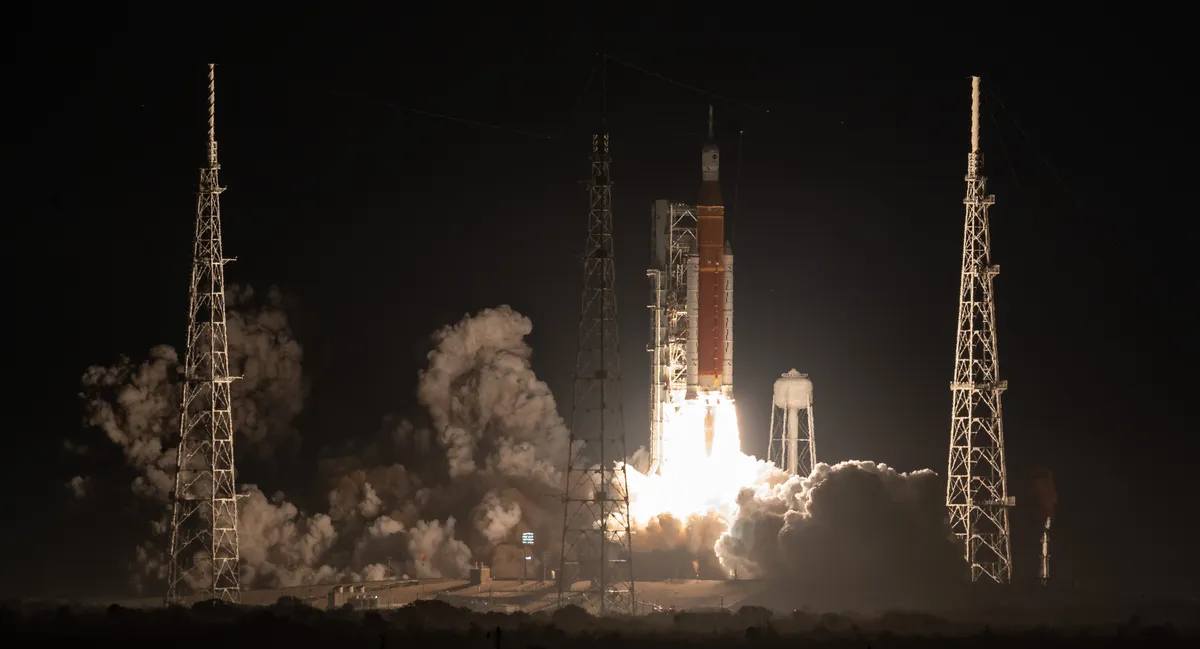
The upcoming NASA Artemis II mission, slated for launch on April 1, 2026, represents a pivotal moment in human space exploration. This mission will be the first crewed endeavor of NASA’s Artemis program, marking humanity’s return beyond low Earth orbit for the first time since the Apollo 17 mission in 1972. The stakes are high, as Artemis II aims to rekindle the global unity inspired by the Apollo 8 mission.
Comprising a diverse crew of four astronauts—Reid Wiseman, Victor Glover, Christina Koch, and Jeremy Hansen—Artemis II is set to perform a lunar flyby and return to Earth without landing on the Moon. This mission will not only be a testament to NASA’s commitment to inclusivity, featuring the first woman, a person of color, and a non-American astronaut traveling to the Moon, but it also aims to showcase the collaborative spirit of international space exploration.
The mission will utilize the Space Launch System (SLS) rocket and the Orion spacecraft, with a planned duration of approximately 10 days. During this time, the crew will experience a re-entry speed of 40,000 kilometers per hour, underscoring the technical challenges and risks involved. NASA has emphasized that precision and risk management are essential, given the agency’s history of spaceflight tragedies.
However, the path to this historic mission has not been without hurdles. NASA has faced delays and rising costs in the Artemis program, relying on private companies for critical components. Furthermore, the Artemis II mission carries inherent risks, including untested life support systems and potential solar radiation exposure. A malfunction during the mission, millions of kilometers away from the nearest help, would leave the crew with extremely limited options.
As NASA prepares for this ambitious mission, uncertainties remain. The launch date is not guaranteed due to potential technical issues, and the effectiveness of the untested life support system during the mission is uncertain. Additionally, the impact of increased solar activity on the mission is unclear. Details remain unconfirmed.
In the broader context, NASA’s long-term vision includes building infrastructure near the lunar South Pole, paving the way for future exploration and potential habitation. As the world watches, Artemis II stands as a beacon of hope and ambition, reminding us of the human spirit’s relentless pursuit of discovery.